New Year’s Resolutions: Are they enough?

I recently got diagnosed with an autoimmune disease. I think I’ve probably had a milder form of it for years, but given my propensity to exercise regularly, spend a lot of time outdoors, and eat a relatively healthy diet, I managed to keep it at bay. Until this past year. The morning oatmeal was replaced by fried breakfasts and pancakes. The swimming, yoga, and hiking became much less frequent. All of a sudden pizza and pasta seemed to make it back into my diet, as did dairy and chocolate chip cookies, and bread. Because these carbs gave me an instant sense of gratification. With a cholesterol 60 points higher, my doctor tried to put me on medication, something I refuse to take at all costs after working for more than 15 years in the pharmaceutical industry. I don’t believe in patching up my problems, but treating the root case.

I’ve fallen off the wagon, I told her, but I’m going to turn things around. I went and bought a bunch of health supplements and vowed no gluten or dairy for at least a month. More vegetables. Berry smoothies for breakfast. More probiotics, more fibre, less saturated fat. No butter, and no pork. More exercise. Less idling. I will cure myself naturally, I decided.

We all set New Year’s resolutions, usually exercise more, drink less alcohol, and eat better. It all seems to centre around the same theme: be healthier. Because deep down we know the healthier we are the better our quality of life will be and the longer we will live.

How many of us actually stick to our resolutions? Why do we actually fall off the wagon? We get lazy and lose motivation. I know I do. I’ll eat healthy tomorrow, or I will exercise tomorrow. It’s so easy to postpone everything until tomorrow, because today it seems like so much effort, and then somehow tomorrow becomes a month or 3 months or 6 months or a year, and before we know it, we are fat, and out of shape, and our blood tests have red highlighted letters all over. My blood chemistry results have always been normal, so seeing all these parameters pop up as abnormal was really a wake up call for me. So I began to ask myself, why am I so de-motivated to take care of myself?

When the weather is nice I find it easy to put on a pair of hiking shoes and head outside, but in the winter, the amount of motivation it takes to get dressed in layers of clothes, and drive somewhere to walk in the freezing temperatures or to go skiing, or drive to town to a yoga class 20 miles and 3000 feet down the mountain, or head to the indoor swimming pool where just the hassle of changing and showering and washing my hair in the communal bathrooms seems hardly worth the trouble. When I get an opportunity to dog sit, I jump on it, because I know it’s the only way I will be forced to walk 10,000 steps in one day.

Everything in winter becomes harder for me. Sometimes when my boyfriend is on shift for 3 days, I won’t shower for 2 days, or even change my clothes, I just walk around in my pyjamas all day. Sometimes I go to bed without brushing my teeth. Making a salad or something healthy to each becomes too much of a gargantuan task, so I just eat small simple meals heavy in protein and starch. I recede to the couch or to the bed and watch t.v. or read articles brief enough to capture my short and equally lazy attention span. It’s complete letting go. After a couple of days of this I usually muster the strength to shower, clean the house, whip up a decent meal. Driving 20 miles to town to go for a swim? No way, that would take an extreme amount of self-motivation and energy that I don’t have.

It seems many of us get hit with seasonal depression around November, so this November I decided to take a road trip out to California and for 2 weeks was visiting all the national parks and hiking almost every day. I thought wow! I did it! I beat the winter blues. But then I came back home and went into hibernation the whole month of December and as quickly as I got in shape in California, I got totally out of shape from hours upon hours of sitting at home. It’s become dead clear that the older I get the quicker out of shape I become.

While it is ok to sometimes be idle and rest and let our body recover from the endless go-go-go we often succumb to in our daily lives, it is important to also keep our bodies in motion. But it is important to also realise what is holding us back from moving. For me, it is the cold and the inaccessibility to the outdoors that I am used to when in milder climates and seasons. I’ve come to realise living at 8400 feet in the Colorado mountains is not for me, at least not for 8 months out of the year. While it is great in the summer-time and in the Fall, the combination of temperatures in the teens, icy roads and hiking trails, and extremely high winds is not something my body wants to tackle.

My New Year’s resolution is to move somewhere warmer, milder, where I can be outside most of the year, be it cycling, walking, paddle boarding, or hiking. The more time I spend outside the happier I am, and the more productive I become inside. My writing projects have fallen by the wayside along with personal self care, because my energy levels are so low. Being active outside has always given me the energy to tackle every other aspect of my life that needs attention.

While New Year’s resolutions are great, they aren’t enough. It’s important to introspect and figure out what is keeping us from achieving those resolutions every other day of the year, and change our lifestyles or environments accordingly, so we can be successful at achieving the things we want to do and become more productive towards our personal goals.

Mele Kalikimaka

Growing up in the 80s in South America to an American father and an Ecuadorean mother meant Christmas was a hodgepodge of traditions probably closest to what one would experience in Hawaii.

Perhaps that’s why Mele Kalikimaka by Bing Crosby would be a recurring tune in our vinyl record player for days preceding the holidays. My parents loved music, and on special occasions like dinner parties, Thanksgiving, and Christmas us kids would be tasked with putting on the shiny black records on the player every evening or before guests arrived. They were happy times, even if most of the year was not.

Our house was large, and in the living room, across from the shiny, velvet champagne-colored 70s sofa and armchairs stood our Christmas tree, next to the piano. It was plastic and overly-decorated with ornaments my mom had collected over the years during her many shopping trips to the USA (buying ornaments was one of her favourite past-times). We would almost always spend our summer holidays in Florida and every now and then travel up north to visit friends and family; she walked into Christmas shops even in the middle of summer to get another ornament for her collection.

Putting the lights on the tree was always an ordeal…what seemed like endless strings of lights stuck into little cardboard wedges in their original boxes had to be wrapped around every little branch, because she wanted it that way. It took forever, and it was also painful, because the spiky fake spruce needles would always poke our little fingers. But she would not relent until after the task was done and all the ornaments were up, equally spaced among branches, and finally, the shiny Christmas star was put on top always with the help of a ladder.  Perhaps more fun than decorating the tree was putting out the intricate Nativity, centred around the pastoral village of Bethlehem on an earth and green-coloured reusable paper we used to simulate the ground. We would set out little plastic goats and sheep, sheep-herders, other miniature villagers inside and around their tiny houses and shops, and of course the manger with the 3 Kings, Mary, Joseph, and baby Jesus. I would spend hours arranging and re-arranging these little figures always creating an imaginary story in my head of who they were in real life and how they went about their life.

Our family seemed happier over Christmas, probably because my parents would put their quarrels on hold, which, in turn, made everyone else happy. I think it’s because both my mom and dad loved Christmas so much that they momentarily forgot about all the things they constantly fought about. I’m sure the jolly Christmas tunes helped calm our otherwise troubled spirits. ‘I’m dreaming of a white Christmas’ and ‘It’s beginning to look a lot like Christmas’ were my favourites, with more traditional tunes like ‘Noel’ and ‘I’ll be home for Christmas’ playing intermittently with jolly songs like ‘Rudolph the red-nose reindeer’, ‘Frosty the snowman’, and ‘Here comes Santa’ for almost 2 weeks leading up until Christmas.

The night before Christmas my parents would always leave out a glass of milk and a cookie. Even though my dad never drank milk, the next morning most of the milk would be gone and the cookie half eaten. I remember always trying to unwrap my presents at 5 a.m. under the dusk light of a tropical morning on the Equator. Wearing my pyjamas, I would sneak out of the bedroom and crawl under the tree, carefully trying to open the folded, taped corners of boxed presents (but never succeeding). I actually believed in Santa until I was 12, when my brother and sister cruelly broke the news to me in the cold concrete staircase that went from the garage to the kitchen so that our parents wouldn’t hear us. I was heartbroken.

My mom knew I did this so she would always afore-scold me the night before ‘no peeking!!’. For some reason my brother and sister didn’t seem as enthused or curious. I was always the one who would impatiently lie in bed until 7 a.m. and then rush into my parents’ room and wake them up so we could open presents, perhaps because I was the youngest. The whole process would take less than an hour and afterwards my dad would make his traditional ‘Sunday’ breakfast: fried sausage links, eggs scrambled or over-easy, his famous sautéed breakfast potatoes with onions and fresh parsley, and toast with butter and jam.

The rest of the day always seemed a little anti-climactic, but when we were young we got to play with toys we had unwrapped and later in the day have a nice Christmas meal, usually honey-cured ham brought from the USA by my dad, as well as his signature German potato salad with fried bacon bits, sautéed onions, boiled eggs, and a sweet glaze sauce. In a way, I think I looked as much forward to the meal as I did to the presents.

Some years we would spend Christmas at our tiny beach house on the Pacific coast, in Punta Blanca, a stone’s throw from the ocean; this was my dad’s favourite place on earth and where his ashes were spread in 2016. We would play Christmas tunes but instead of a huge tree, we would just put up a little plastic tree with less decorations, and hang our hand-made felt stockings on the fireplace, which he built out of stone slabs for those chilly nights on the coast when the temperature would drop into the high 60s.  We each got a handful of gifts but it was nothing over-the-top like what you see now. I think that was mostly because most of our gifts were bought in the States during my dad’s business trips and they all had to come back in a reasonably-sized suitcase. My favourite were always the stocking stuffers, more bang for the buck, more stuff to open, more surprises. The living room was cramped as we all sat on our wicker furniture adorned with pink and turquoise cushions. We would hear the waves crashing against the shore, and somehow we knew Christmas wasn’t really supposed to be that way, with sunshine, palm trees, a warm sea breeze, and plastic trees. But we didn’t care. The cramped living room was always a mess after opening presents, with crumbled wrapping floating everywhere.

I do miss those Christmases growing up.  It seems ages since I’ve had a truly happy Christmas. Maybe it’s because this innocent happiness is something only kids are able to experience. Or maybe it’s because I’ve changed. Or we all have. Maybe Christmas means something else these days. Back then, everything was simpler, even the joy of Christmas.

In the meantime, I like to listen to those old holiday tunes and remember my childhood Christmases in Ecuador, tropical style, and once in a blue moon, when the Christmas radio plays Mele Kalikimaka (Merry Christmas in Hawaiian), I can’t help but get a nostalgic smile on my face.

P.S. This is a picture of my dad’s last Christmas in 2014, in Florida. He loved Christmas.

Carte Blanche

Does having problems give you carte blanche to be a jerk?

I used to have problems. Not problems anyone gave me but problems I created for myself, mostly through bad choices. I stayed too long in a job I hated. I dated all the wrong kinds of guys. I would let stress get the best of me. I dwelled on my shitty upbringing and used it as an excuse to be bitter. I had little patience, lashing out on people I found incompetent or annoying. I didn’t pay enough attention to my friends.  I wasn’t grateful enough. I said things I shouldn’t have. I was a jerk and the worst I felt the bigger the jerk I became.

Then one day I woke up from this nightmare that was my suboptimal, unhappy life and I decided I had to change. I had to start from scratch. I had to quit my job. I had to stop blaming my mother. I had to reduce my over-the-roof stress levels that left my thyroid depleted and my adrenal exhausted. I had to stop being angry. I had to start being nicer. And in order to do all that I had to start taking care of myself and start being happier.

The whole re-conversion took almost 2 years, then my dad died, and it all kind of came tumbling down, though this time I could sort of deal with it better because I knew myself better, but I still treated my boyfriend like shit more often than I should have and at some point I told myself, either break up with him and spare him the misery or just be nice to him. Because it’s not fair to him that I am taking out my misery on him.

You see having problems is not carte blanche to treat other people like shit. If you need to be alone for a while to sort your life out then do it. If you need to make big, drastic changes then do so. But stop using those around you as a punching bag. They don’t deserve it. At least admit it to yourself and start from there. Everybody has problems, even if you think your problems are bigger than everyone else’s and entitle you to lash out on everybody else. They don’t. You’re the jerk who ends up feeling bad for making them feel bad. I know I did.

Mother vs Dogs

While I finish my book, I dog sit. When I am not traveling, I dog sit. I don’t always dog sit. I have a few regulars who call on me during the holidays or when they’re on vacation. It’s not a regular thing and it surely doesn’t bring in a lot of money. It is more of a hobby. A way to bring in a little spending money. A way to keep busy. A way to spend time with dogs, creatures who are uncomplicated, loyal, and accept and love you no matter what.

I cannot say the same thing about my mother.

My mother is the overriding subject in my book also titled ‘The Bear That Moved’ (80% complete, 100% un-edited). I won’t talk about her here except to quote her latest WhatsApp message when she found out I wasn’t going to be spending Christmas with her, my sister, my brother, and a bunch of other people from his wife’s family, because I had already agreed to take care of 3 dogs weeks before my brother decided to invite the whole family to his home in Georgia for the holidays.

The message goes as follows (translated from angry, Latin-American Spanish):

‘I just found out from your brother that you are not going to Atlanta because you have to take care of a dog (not bothering to acknowledge that it is in fact 3 dogs), giving the impression that an animal is more important than your family, and in addition it is the second time that when I ask him about you he says that he calls you and it seems that you are always too busy to speak to him, I don’t think that is right and daddy (she always brings in the dead guy) would think it was right too. Finally (thank God, I was wondering when her sentence would end and the period would be utilised!) it is your decision and I will not talk more of the matter.’

There are a few important things to note in this message. First, she would give Gabriel Garcia Marquez a run for his money with her excessive use of comas and utmost hesitation to end the damn sentence. Yes, she needed to get her frustrations out. I just wish she would have breathed a few times through her paragraph long sentence.

Anyway, I want to get some facts straight in my defence. Not that it matters to her or my brother who seem utterly victimised by my lifestyle and choices.

  1. My brother is a good guy but the fact of the matter is he hardly ever calls me. His work is all-consuming and everyone else is just a shadow walking by in the periphery. When he calls, which I appreciate, I answer if I am available. Only recently has he begun leaving voicemails, and I acknowledge them right away and offer to call back. But then he’s ‘busy’  and can’t talk. When I was in California for a month he called once, and it went to voicemail, and I didn’t get the voicemail until I returned to Colorado, along with 18 other voicemails stuck in cyberspace, because there was something wrong with my phone. I notified him of this right away. I still cannot figure out why he couldn’t text to say he wanted to talk. Usually when I call him he’s in a bad mood, or stressed, or sad, I never know because he never wants to talk about it. He only calls on his way to Starbucks, usually after he’s called my mother and my sister. He is usually not very chatty, and seldom offers any information about anything happening in his life. There have been many times these past few years that he has sent me rude and hurtful messages, which I eventually chose to forgive and ignore because I figured he was unhappy and just taking it out on me. When it is me who writes him I usually get a one word answer. ‘How’s it going?’ ‘With what?’ ‘How are you?’ ‘Fine’. What better way of telling your sister you enjoy being in contact! This makes it hard to want to talk to him but I doubt he’s ever bothered to put himself in my shoes and see the situation from my eyes. And yes, I have a busy life too. I travel a lot and when the weather is nice and my boyfriend is home I am out having fun because life is short and I may get run over by a car crossing the street or die of an aggressive brain tumour or get shot in a public place by a Trump supporter. It seems people always resent the fact I am out having fun and living my life to the fullest and not partaking in their misery.
  2. My mother has aways been dis-intersted and self-absorbed on her best days, and spiteful and overly critical on her worst days.  She always thinks everything is about her, refuses to ever see anything from someone else’s perspective. Honestly, I think she can’t help it. That maternal instinct to care for her young didn’t make it through meiosis. Her brain is just wired different from most mothers’ and it’s taken me about 40 years to accept that. She wouldn’t bother to understand that my brother didn’t invite me to his house for Christmas until November 12th. I mean, who waits until November 12th to make Christmas plans besides a total loser with no friends or family? I had already committed to taking care of Hobbie, the 14-year old Golden Retriever I have been looking after the least 2 years. She’s nearing the end and her owners always ask me to look after her when they go out of town. Hobbie was probably one of my first friends in Colorado (even though she’s got 4 legs she can still be a friend!). I have probably spent more time with her than anyone else besides my boyfriend. She thinks I am awesome, loves having me around, and we have had many lovely walks and hikes together, where she never complains she is tired even though her arthritis is probably killing her. That’s more than I can say about some people in my family. After I had agreed to look after Hobbie at her house, some friends of ours who I had dog sat for back in October asked me to look after their two dogs over Christmas at their house; Romeo is a 14-year old Husky and Lily, a cattle mix about 5; both sweet, well-behaved pups (Lily likes to sleep in bed with me). Partly eager to help them out over the holidays when it is hard to find good petsitting, but also wanting to earn a bit of extra cash to pay for holiday gifts. But because Hobbie is old and cranky she cannot stay with other dogs, so my boyfriend will have to stay with Romeo and Lily, and I will have to stay with Hobbie. My boyfriend has a few days off over the holidays but has to work on Christmas Day, so the 24th we will meet for a few hours to have dinner and each sleep at our respective houses after we have each walked the 3 dogs 4 times a day. So after all these logistics were put in place, my brother says hey, we are having Christmas at our house, you are welcome to come! So was I supposed to leave Hobbie, Romeo, Lily and boyfriend on the street? Is that what a good daughter and sister would have done?
  3. The dead guy. My dad died in 2015. It is one of only 2 chapters in my book that still hasn’t been written because it’s something that’s very difficult to write. Not just his death itself, but the circumstances surrounding it, the years preceding it, and all the family drama and animosity between several family members, all the things left unsaid, and bitterness cast deep in bones. But it will get written, and my views on what transpired will get said, though I am sure it will upset a lot of people. Somehow my mother still clings on to the dead guy, even though the dead guy had left her years ago and moved on. The dead guy in fact had another girlfriend, who inherited most of his money. The dead guy didn’t care much for my mother, at least not for the 10 years before his passing. So it is always amusing that she clings on to his memory for dear life, as well as a photo of him from the late 60s where he said he would love her forever (never believe what men say, ladies, nothing is forever!). I always think of what my dad would think of what I am doing. I always wonder, would he be disappointed in me? Would he be let down? I do believe he’s somehow always with me, seeing everything I do, and though paralyzing at times, I try to act like a decent human being given the shitty upbringing I had and my personal circumstances (I am far from perfect but I am always trying to grow as a person). So I wonder if my dad is really floating up in the multiverse interspace looking down on me thinking ‘Julie, you are a really shitty person for not spending Christmas with your family and instead taking care of 3 dogs who you committed to taking care of before your family bothered to invite you for Christmas!’. NO. My dad most defiantly would not be thinking that. Sorry to break the newsflash to my family, but I was my dad’s favourite. That wasn’t because I was the prettiest, or the smartest, or the one with the PhD, but because he saw something in me that was a lot like something in him. My dad always acted according to his will, he didn’t care what anyone else thought, he could be rude, yes, abrupt, yes, thoughtless, yes, but he followed his heart and that’s something 80% of people don’t have the guts to do. So leave the dead guy out of it. He’s on my side. And he always told me I should be a writer, so is probably proud I am finally writing.

My mom’s WhatsApp left me in a really bad mood yesterday. I was told by several previous managers to wait 24 hours before responding to an email that made me angry. Because my response was never pretty. I couldn’t wait 24 hours to respond to my mom’s WhatsApp. I fired back, said what was on my mind. And that was the end of that conversation.

Families are complicated. People are complicated. The holidays seem to bring the worst out of everyone. Everyone gets so stressed about having people come visit, buying gifts, mailing Christmas cards, cooking a meal everyone will enjoy. Christmas has turned into this ridiculous excuse of a holiday where people who are supposed to be kind and loving to each other the way Jesus intended, instead morph into monsters who rip into each other or at the very least, are unkind. Last year at Christmas my autistic niece who ‘talks’s via her mom told me I was ‘the worst one in the family’ when it came to being hurtful and tactless. What hurt me the most was that she felt the need to say this a day after Christmas, that at every family get together the family has to sit around an offer some form of criticism. Yes, I am direct, and I tell it like it is, like my dad. The baton of ‘the worst guy’ has been passed on to me.

And then they wonder why I rather spend Christmas with 3 dogs?!

God bless the dogs.

They’re allowing me to spend Christmas with 3 creatures and a boyfriend who think I am great. Or at least not the worst.


The Wilderness Experience

They say nature does the body good and that hiking is not only healthy for your body but is also good for your brain because it requires enhanced situational awareness and sharpens your mental acuity. But I do it mostly because I enjoy being outdoors and, living in Colorado, I am surrounded by mountains. In my mid-40s, it is also a great way to stay fit. And last but not least, it is something my boyfriend James and I enjoy doing together.

This last weekend James proposed we do the High Lonesome loop in the Indian Peaks Wilderness just a few miles from our house. He always ‘sells’ these backpacking loops as easy-to-moderate, and I always naively believe him. This particular loop is 15-17 miles long (depending on which website you look at) and demands a long, gradual ascent of 2,500 feet over 5.5 miles on Day 1, arriving at Devil’s Thumb Lake at around 11,000 feet, where we planned to camp for the night. On Day 2, we would climb another 800 feet to Devil Thumb’s Pas and walk 3 miles along the the continental divide trail (CDT), a famous long distance trail connecting New Mexico to Montana and spanning 3,100 miles, also known as one of the Triple Crowns together with the Appalachian and Pacific Crest Trails.  After that we would drop down into King Lake and take a very long (6 mile), gradual descent back to the Hessie trailhead where we started. It sounded great, and surprisingly doable.
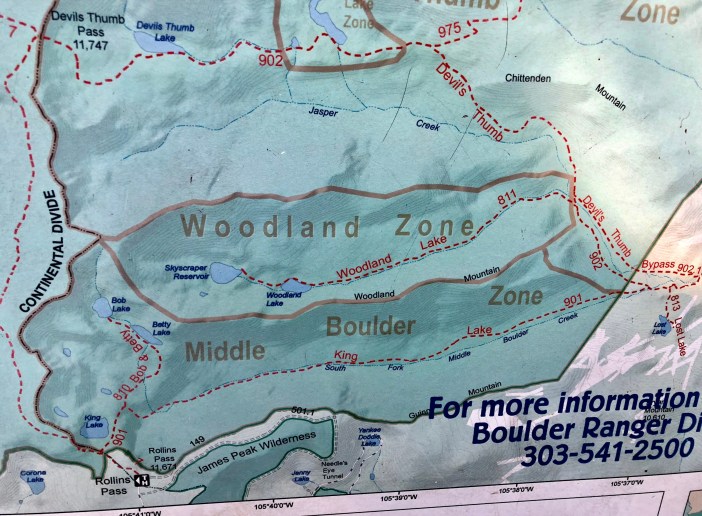
trailmap

What I didn’t really factor in was that I would have to carry a heavy pack. I tried to pack light as we were only going for one night, and I have certainly carried heavier packs on backpacking trips to the Grand Canyon, the Tetons, and on the Tour de Mont Blanc. But I had been gallivanting at sea level for about 3 months, first driving to the Oregon coast, taking long beach walks before heading to Bowen Island in British Columbia for a dog sitting gig where I spent most of my time playing with two dogs on the beach. Then I went to Cape Cod to visit my sister and continued walking on the beach and doing some leisurely bike rides, before going to Northern Georgia to look after my brother’s dog and where I actually did some hiking (at most 6 miles) but only on gently rolling hills and at a few hundred feet above sea level, usually after doing morning laps in the neighbourhood pool. Oh, and I had climbed a 14er a few days prior (7 miles round trip), and even though my calves were still a little sore from that excursion, I thought I was in good enough shape to hike 15 miles (it turned out to be just over 20 on my pedometer), and living at 8,400 feet, I thought I would be sufficiently acclimatised to do it.

The first day was a hot one, probably in the mid 80s (thanks to global warming it now gets this hot at over 9,000 feet above sea level). Though my pack felt heavy and the straps kept pulling on my shoulders, the thing that bothered me the most was walking 6 hours uphill in the unrelenting heat. The first 2 miles or so of the trail followed an old rocky mining road without any shade. I was pretty miserable and being a Latin woman and a person who always says what she thinks, I started to complain. James asked me why I do it (backpacking) if I hate it. First of all, I don’t hate it. You can feel miserable doing something you like. I hate being too hot, that is why I thrived in Scandinavia for 6 years while most Latin women wouldn’t have. When we finally got out of the road and entered the Indian Peaks Wilderness area, we were surrounded by alpine meadows peppered with patches of wildflowers like pink asters, yellow alpine sunflowers, white bear’s breeches, bright red Indian paintbrush, and purple bellflowers. The path became narrower and smoother, and even though there was still very little shade as we were now entering the tundra, we could feel a light wind and see the striking Front range in front of us with a few remaining snow fields. This is where all the pain associated with hiking and especially backpacking becomes worth it; when your surroundings look like you’re in an episode of Heidi.

We stopped for breakfast in a pretty meadow then continued onto Jasper lake, which the City of Boulder had mostly emptied to fill the Boulder Reservoir in Nederland. My boyfriend James had been to this lake a few weeks ago when it was full and had told me how beautiful it was, so we had planned to stop there for lunch. But 80% of its water was now gone (so that Boulderites can water their lawns and wash their Range Rovers growled James). Only barren, dried out rocky shores were left, so we sat under some trees about 50 yards from the lake and ate our lunch on a fallen tree trunk and continued onto Devil’s Thumb Lake about a mile further up the path to set up camp for the night. 
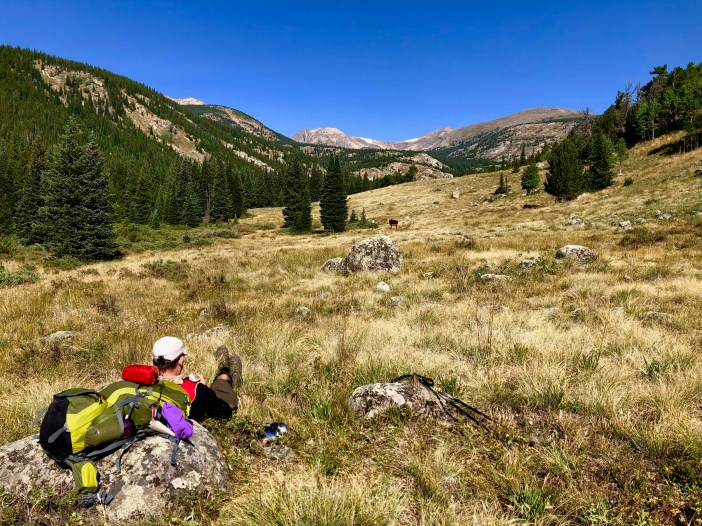
jamesfirstdaybreakie

At this lake you can only camp with a Wilderness permit as there are no designated campsites. We only saw one other couple (the girl was wearing running shorts and a tiny camelback pack and her boyfriend had a small backpack with two sleeping bags hanging off of it and part of me was jealous at the lack of weight behind their backs).  We picked an idyllic spot in the shade surrounded by trees and only 30 feet/10 meters away from the lakeshore (even though regulations want you to be at least 100 feet from the lake). I stripped most of my clothes off and went into the water with my Crocs and took a little French bath, something I always do when I get overheated, no matter how cold the water is (my trekking mates in Nepal would smirk when they would see me jump in to a glacial river to cool off). We set up our small 2-man tent, which took forever, and then took a nap, before getting up to cook dinner, a freeze dried bag of Mesquite BBQ chicken with beans and rice, which gave us the worst bout of gas I can remember, something you don’t want to have when sharing a tent with your partner.  James had brought two small bottles of red wine, and I had brought a bar of Madagascar dark chocolate, both of them a nice campsite dinner treat. We sat by the edge of the deep, blue lake surrounded by glacial scree and imposing granite cliffs, until the sun went down.  

Since there typically are bears in the area and someone had spotted a black bear the day before at Jasper Lake, we hung all our food in a metal mesh, bear-resistant bag up on a tree. James had to precariously climb up a stubby pine and secure it a couple of meters off the ground. After his little climbing adventure, we walked out to the meadow to do a reconnaissance of the next day’s climb up the pass. We had met several people on the way up who had told us how steep it was and I was scared I wouldn’t be able to make it. But after looking at it it seemed a piece of cake compared to all the high alpine passes we had done in the Maroon Bells or the Tour de Mont Blanc so the plan was to get up at 6 am and start our ascent by 7.30 am before it got too hot. The wildflowers at this altitude where still in full bloom so we took pictures in the meadow and with the mountains and the lake and the impending pass in the background. It was a beautiful evening and the light was just right. On our way back to the tent we saw a group of boy scouts who had arrived after us, and also the young couple from before. They had planned to climb over the pass too but the girl, who turned out to be a flight attendant from San Francisco, looked really nervous. She was still wearing her little shorts. Her boyfriend had no map, and no idea where the loop trail continued after the pass, so we offered to show them our map in the morning and told them we would be setting off around 7.30 am in case they wanted to follow us.
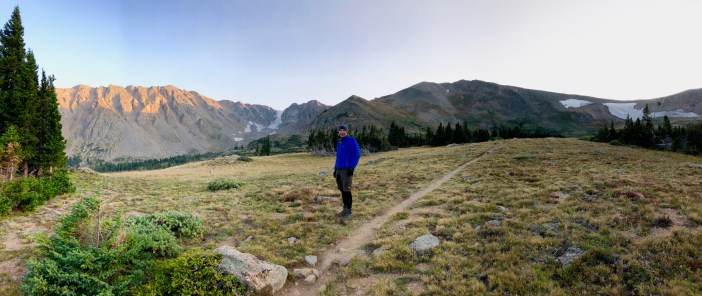
jamesbelowpasspanoshot

One of the things we wanted to see on this trip was the Perseid meteor shower, which some girls who we had run into on the path and who had camped at Devil’s Thumb Lake said they had seen the night before. So we set our alarm clock for 10.30 pm. James fell asleep instantly, but I was so cold I could not sleep. I was shivering even after wearing wool thermals, a down jacket, and being in a silk liner and in a down sleeping bag. Just a few hours before I was so damn hot and now I lay freezing.  The half bar of 77% chocolate I ate after dinner probably didn’t help either. I lay awake until the alarm went off and we went outside to the meadow and stood under the pitch black sky, watching the stars and the impressive Milky Way, still shivering, and voilà, a minute later a huge meteor shot across low in the sky with its bright white tail. The next one was equally bright. We saw 5-6 smaller meteors and decided to go back to ‘bed’ because we were so cold. This time I put my wool hat on and wrapped James’ down jacked around my feet. I finally warmed up but couldn’t sleep. James was peacefully sleeping next to me within 10 minutes. How he always manages to fall asleep so quickly no matter where we are really baffles me. I eventually dozed off, finally snug as a bug, when I was awakened by some thumping outside our tent that sounded like a person walking. But I didn’t see a light so thought it was odd that someone would be walking in the dark. All of a sudden I heard a tapping sound. I then wondered if it wasn’t a person but a bear and the the tapping was him trying to take down the bear bag. 

James had told me a story that earlier this summer a bear had ripped into a tent and grabbed a young man and pulled him out of the tent while his friend fought to pull him back in. I thought about waking James up but he was sleeping so peacefully, and I knew telling him there might be a bear outside wouldn’t make the bear go away. I normally drink a lot of water at high altitude (we were at about 11,000 feet), but I didn’t want to drink as I didn’t dare to go outside and pee. I managed to fall back asleep eventually, intermittently awoken by the same sound. At some point James woke up too, because the wind had picked up and was now flapping our wilderness permit and our inflatable solar lamp both hung outside our tent. I told him about the steps I had heard and he told me it was just the wind. Then he heard them too and said yeah, that it sounded like a bear, with trepidation in his voice. We flashed our headlamps outside but couldn’t see anything. We lay awake in fear for a while, me waiting for the damn bear to rip me out of the tent while James fought to keep me in, but eventually the bear left and we both fell back asleep.

Of course after that night’s ordeal and about 2-3 hours of sleep at most, for me at least, the alarm went off at 6 am and I immediately pushed the snooze button. I kept pushing the button a few more times and we didn’t end up getting up until almost 7 am. After dissembling the tent, cooking breakfast (the bear bag was still there when we woke up), packing, and several bouts of upset stomach (dehydrated food does not sit well with us!), we finally managed to leave our campsite at 9 am, 1.5 hours behind schedule. So much for our alpine start!

julieclimbinguppass.jpg

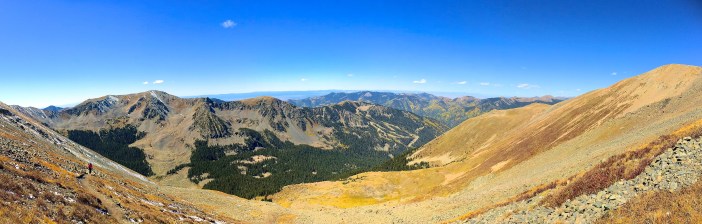
We got up the pass in a surprising 45 minutes. The wind from the previous night still prevailed and kept the temperature cool despite the sun already shining brightly on the moderately steep, narrow path up the pass.  I had eaten an energy shot and drank a lot of water and like a determined camel slowly but steadily climbed the 800 foot pass feeling relatively energised and without feeling an ounce of pain. The views from the top were worth it (James promised they would be). We were standing right on the continental divide, the highest and principal divide of the Americas, with views of Rocky Mountain National park, the valley below us from where we’d come and also on the other side where the town of Frasier sits, the Winter park ski resort, as well as miles and miles of the Colorado Front Range. It was a truly spectacular panoramic 360-degree view of the Rocky mountains, alpine tundra, green valleys and clear blue sky. When you stand at the top of a mountain with such views the pain of backpacking becomes worth it. I think all adventures and achievements must always carry a certain degree of suffering, otherwise everyone would be privy to the same unique experience that only those willing to suffer are deserving of. Of course the fitter you are the less you suffer and the more enjoyable hiking or backpacking are. But knowing I wasn’t in great shape and hadn’t carried a heavy pack since my 6 week backpacking trip in Asia last winter/spring, I still decided to try it, knowing there might be some degree of suffering involved but that it would likely be worth it.

The only people we saw at the top of the pass were the group of scouts who had camped by the lake. James talked to their scout leader for a while, we had a snack, took some photos, then continued on a section of the CDT, known as the High Lonesome trail, for about 3 miles at an altitude of about 12,000 feet. We saw a few fat marmots scurrying around large granite boulders right at the crest of the divide as well as some pika, an alpine rodent that looks like a large squirrel with no tail. We stopped and watched a particularly cute little guy traipse across the rocks to the edge of a short bed of shrubs to pick some red-tinged branches (I later found out they were bearberries and part of the tundra biome), which he would carry in his mouth (always with the flowering end on the left of his snout) and tuck into a small opening in the rocks. James guessed he was building his nest for the winter. He kept running back in the forth just next to us in an industrious scurry as if he was on the clock. The walk along the divide was spectacular, and we only ran into one couple and a lonesome hiker over a period of two hours.

jameswithCDTbehind

jamesCDTpano

Eventually we found the turn off down to King Lake, a couple of hundred feet below us, at the top of the adjacent valley to the one we had hiked up from. This is by far one of the most splendid alpine lakes I’d ever seen, and after 6 years of living in the Alps and hiking almost every weekend, I had seen a lot of spectacular lakes (my favourite were Lac de Chésery and Lac Blanc just above Chamonix). I had inadvertently brought my polarized sunglasses on this trip, which I had bought for fly fishing, and from over a hundred yards away I could see 12-14 inch trout swimming along the edge too the lake or jumping over the surface in the deep to catch an fly. The water was so clear and sapphire blue that it reminded me of the Mediterranean. You could even see the boulders under water close to the edge. We walked down to the lake on sat on a huge boulder a few hops from the shore, and ate a little snack while I dipped my feet in the cold water for a few minutes. My feet were sore and hot, one of the drawbacks of wearing only flip flops or Birkenstocks for almost 3 months is that when you put on a pair of hiking boots and walk in them for 10 miles with an extra 20 pounds of weight on you, you feel someone is crunching and twisting your feet in a medieval torture device. James’ stomach was still hurting so he could neither eat or drink anything. But for these few blissful moments sitting at King Lake all the pain and discomfort were forgotten.

jamespanokingslake

After a short rejuvenation by the brisk cold water, we made a rapid descent down a nice track flanking a lush valley surrounded by green shrubs, a few patches of surviving wildflowers, and pine trees, crossing the creek a couple of times, for a good 2 miles until we started to hear thunder. Great dark clouds loomed just behind us, so we tried to walk faster, almost running down the path. There were a few rocks and branches, some steep steps, and I realised this is why hiking is good for your brain. It forces you to concentrate on every step you take. If you hike for 15 miles in the forest, up a steep slope, or through a rocky path, considering that the average mile encompasses 2,000 steps, you are taking 60,000 steps during which you are having to focus 60,000 times on your footing to make sure you don’t trip and either twist an ankle or fall to your death (my phone actually clocked 51,250 steps). Even though hiking can be very meditative and therapeutic, it can also be mentally draining if you’re always having to focus on where your feet are at all times, while trying to take in all the splendour of the surrounding nature.

The last 3 miles of the hike were the worst, and about the time when I start to get into a really bad mood. My feet were in some of the worst pain I’d ever felt, my shoulders were aching like hell, and I was exhausted. Thankfully it wasn’t hot or I might have been crying. The remaining 2 miles we hit the same awful, rocky mining road we had walked up on the first day, except that coming down you have to be 10 times more careful not to slip and fall. If you did you wouldn’t die, you’d just fall on your ass and it would hurt, and you would look stupid to the dozens of hikers who traverse the path on their way to Lost Lake, a small, unimpressive alpine lake a couple of miles from the trailhead, which all the Boulderites like to visit, along with tourists from Texas. 

It is customary when you are hiking to greet other hikers. People often ask, ‘Hi! How’s it going?!’ This is great gesture if you’ve only been hiking 2 miles in light running shoes, carrying a tiny backpack with a rain jacket and a liter of water. But don’t ask the out-of-shape grumpy girl who’s just been walking 17 miles up and down a big pass with a huge pack with a sleeping bag, a stove, lots of layers, snacks, 2 L of water, a poncho, a bag of toiletries, some first aid supplies, who feels like her feet are being triturated, her shoulders are about to fall off, and who slept 2 hours the previous night because she thought a bear was going to eat her, how it’s going. I walked these two miles looking down, hiding under my cap, biting my lip, avoiding eye contact with anyone so I wouldn’t have to answer that question. I took 4,000 short, extremely painful steps over thousands of small rocks on this arid path under the beating sun to get to the parking lot. But of course we couldn’t get a parking spot in the parking lot the day before so James had to park almost a mile further down the road.

At some point James asked me how I was feeling. ‘I’m not feeling well and I just want you to go get the car!’ I snapped. He walked off ahead of me, and on top of all the pain I was in, I had the added pleasure of feeling guilty and ashamed that I had snapped at my boyfriend who had carefully planned a backpacking loop he had coveted doing for weeks, ending it all in misery and angry words. But I am entitled to feel how I feel. And if I am suffering someone has to feel bad for me too, right? That someone might as well be me. I soldiered on to the parking lot where he had left his pack while going to fetch the car. I saw people driving up and down the road with Minnesota, Nebraska and Texas plates, trying to find a parking spot, so they could go do their short hike to Lost Lake in their running shorts and shoes and their tiny packs. This time I didn’t gawk with jealousy but instead looked at them arrogantly. I’m the badass girl who just hiked 17 miles up a huge mountain with a heavy pack. I’m in pain and I almost want to cry, but I wouldn’t change a thing. I would still go back and climb that stupid mountain. I know I’ll recover and in a few hours and when I’m editing my pictures I will fully appreciate the beauty of this experience. The meteors, the bear, the alpine lakes, the meadows full of wildflowers, the meal with an iconic view, snuggling in the tent with my boyfriend, the great sense of achievement, and the wonderful views. This, and all the underlying pain, is what the wilderness experience is all about.

bothofustopofpass

The accidental wedding guest

As part of my 6-week Asia trip, I chose to visit Cambodia, Laos and Northern Thailand. My first stop in the last country was a town called Pai, a small town in the Mae Hong Song Circuit, which was overridden with tourists, most scantily clad, European under-30 year olds most of whom were smoking cigarettes. Feeling like an old lady and disappointed at not being able to experience the real Thailand, I turned to an online blog for SE Asia travellers where a local expat recommended I try a less popular spot. I did my google research and stumbled upon Mae Sariang, another town on the circuit that sees much less tourists. So I rearranged my travel plans to spend the next to last week of my trip there, and organized 2 days of trekking with a local guide, whom I was hoping would introduce me to the Karen hill tribe culture.

Piak, my guide, called the day I arrived and invited me to his cousins wedding in a nearby village the following day, a day prior to our scheduled start to our 2 days of trekking. I wasn’t expecting to attend a wedding, and I assumed it would be a somewhat formal affair, so that evening I walked up and down the main street, which wasn’t very big, in search of a dress as I had only brought trekking clothes with me. I found a small shop selling second-hand clothes that looked like they’d been donated from your local Goodwill. I purchased a below-the-knee short-sleeve white dress for the occasion.

The next day Piak came to pick me up in his scooter and I assumed we were going to his village first before heading to his cousin’s wedding. Here I discovered rule #1 of traveling in Asia (and about life in general I guess): never assume anything.

I decided to take all my clothes and toiletries thinking we’d drop them off at his house, but actually we were heading straight to the wedding; at some point Piak saw a pick up truck full of wedding guests so he decided to transfer me and all my crap to the already replete pick up wagon full of Jgaw Karen tribe ladies known for their characteristic headdresses. We were all pretty much sitting on top of each other and the driver was going up and down this winding road like an Indi 500 driver. I thought to myself, this is how I’m going to die, in a roll over 200 km from the closest city in a pick up full of tribal women. I just felt sorry for my poor mother and whoever had to bear her the bad news.

But we didn’t die. We were dropped off by an embankment onto a dirt path and we all walked single file up the hill surrounded by jungle to a tiny village with maybe 5 bamboo houses on stilts for a wedding feast in the groom’s father’s house (the wedding was actually yesterday in the bride’s village). I was wearing flip flops, normal clothes, and carrying a back pack full of clothes, shampoo, lotion – enough for a week long stay – up the jungle for no reason. So by the time we arrived at the village I was drenched in sweat and realized the dress I had bought for the wedding had gone in the other scooter with Piak’s wife who actually wasn’t coming to the wedding. (I was told at the wedding that only young girls attending the wedding wear white dresses to weddings so its actually good I did not wear mine!)

The wedding was actually a quite simple affair, held in the groom’s parents’ village home, a simple bamboo house on stilts, in a hillside settlement with no electricity or running water and only a handful of homes. The house did not have any furniture so we sat on the bamboo flower, eating a delicious meal of mostly richly spiced pork stews and rice prepared by the village women. Everybody was sitting cross-legged or squatting, even the village elders. A sweet old lady who looked to be in her 80s offered me a cup of Sprite, in a plastic cup that looked like it had never been washed in soap and water. I knew the plates or utensils I was eating from had also not been properly washed, and the rice I was eating was boiled in water from the nearby stream. Drinking soda, I guessed, was not customary and a real treat, along with the meat, so I could not decline either drink nor food. Through a crack on the bamboo floor I could see a pig being strangled and bled to death. It is the custom to send each wedding guest with a plastic bag full of fresh pork meat as a thank you gift.

I spent about 3 hours at the wedding and was unable to talk to anyone as they did not speak English and I did not speak their local dialect, so I just watched people eat and interact, and witnessed the couple handing out gifts (for it is the custom for the newlyweds to give the elders and most distinguished guests a gift, not the other way around). I sat next to older men who stared at me in wander smiling and took it all in, for I knew this was a once in a lifetime experience.

On our way back from the village to the road, I walked with a group of Karen women, one of whom was very drunk and had to be held up by a younger girl.

After the wedding we headed back to Piak’s village where I was to spend the night with his family, his wife and two daughters, Rita, 6 and Teresa, who was turning 11 that day.

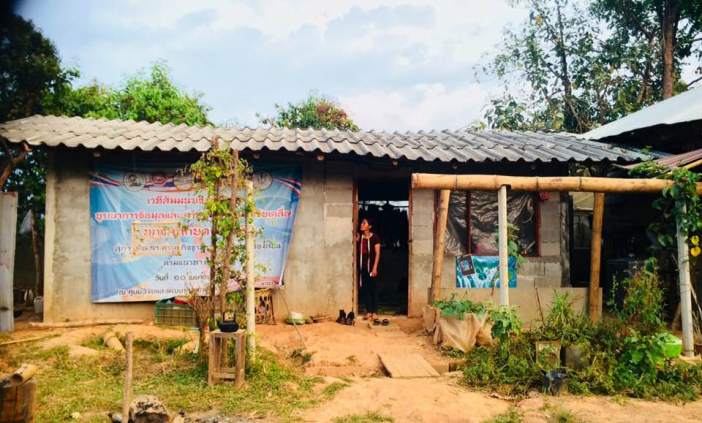
Piak’s house was very simple, only 2 rooms, one the family bedroom, the other his wife’s sewing room. There was an outhouse with no door and a squatting toilet built into the ground and barrels of river water for bathing and flushing. The traditional Karen kitchen was in a separate bamboo building high off the ground on wooden stilts.piakshouse

Piak and his wife cooked me a traditional meal using vegetables from their own garden, which is in front of their house, and the pig meat from the wedding, which had been sitting out all day as they have no refrigerator. They made several dishes and I was so stuffed I could hardly eat the half pineapple they gave me afterwards.

The kitchen, like the bathroom, had no running water, so barrels of water are used for washing dishes. The food was delicious and my hosts wouldn’t eat until I did. We all sat on the bamboo floor to eat as there was no furniture, only the traditional ceramic bucket-shaped stove for cooking. Teresa washed all the dishes and Rita tried to help with the chopping. Seeing a 6 year old with a blunt knife trying to chop a miniature garlic clove was pretty scary. Kids are so well behaved and obedient here I began to wonder who’s the developed country after all.

Piak slept in the kitchen and his wife and kids in a tent in the sewing room. They gave me their bedroom and set up a mattress and mosquito tent on the floor for me. It took me a long time to fall asleep, then I woke up because it got very cold at night and the house is only made of cinder blocks, a tin roof, and no windows (only a plastic sheet covering any openings). I managed to fall asleep again with my down jacket and then the damn roosters started crowing at 5 am.

I was shocked that with what little they have they were giving me so much food and all their comfort.

This morning after breakfast, Piak took me and the girls and two of their friends, and his dog, trekking in the jungle close to his house (by then my stupid phone had run out of memory so now pictures to show). We hiked up and down through a heavy forest to a beautiful valley filled with terraced rice patties, which in the winter they use for growing cabbage. We had a picnic lunch on a bamboo day shelter belonging to his brother in law. The girls ran around in the rice patties after lunch and then we walked up the hill back to his village in the hot afternoon sun; close to the village a friend of his gave us a ride in the back of his pick up truck to the gas station to buy ice cream – my treat for the girls for coming trekking with me for 5 hours and for being such good sports.

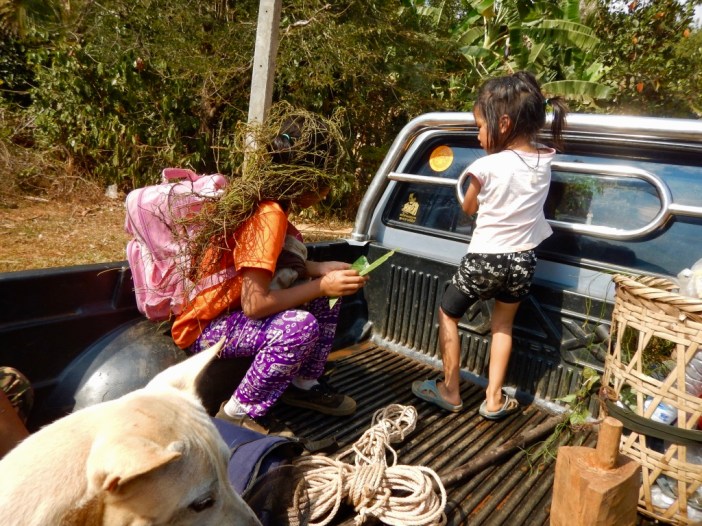
Riding back to the village in the back of that pick up truck with 4 little girls full of sticky ice cream stains and dirt from rolling around in the fields and what seemed like the world’s most content dog was really a highlight for me. I haven’t seen so much happiness in one place at the same time in a long time!kidsinpickuptruck

At home we spent a few hours preparing dinner – I’m learning a lot about authentic Thai cooking and nowhere on the menu these last two days was a Pad Thai or a curry!! Tonight one of Piak’s friends, Naveen, came to meet me – he lives 1.5 hours away! He and Piak did all the cooking and I helped chop the vegetables. Other men and women from the village stopped by for coffee during the process. It felt like such a great sense of community. Everyone here seems to friendly and close to each other.

I decided to spend the night at a guesthouse close to Piak’s village because I was in desperate need of a hot shower after sweating for 2 days in the jungle. And I also felt like I was really invading their space even though they invited me to spend 3 nights with them. Besides I was getting fed up with all that squatting and everything hurt when I sat on that bamboo floor for more than 30 minutes.

After a short respite at a simple guesthouse next to an abandoned gas station by the side of the road, I got picked up by Piak and his friend Naveen, also a local guide and farmer, and we went hiking in Ban Mae Sawan Noi national forest close to Mae Sariang. Our ultimate destination was the waterfall with the same name.

We started our loop in the hills just outside the national forest where local farmers plant cabbage, red beans, and shallots in the dry season, and rice in the rainy season, which starts in June. This is mostly done as rotation farming – after planting crops for a few seasons farmers must let the jungle grow back and plant in a new location, which is sometimes cleared by slashing/burning the brush.

The fields in this region are planted on steep inclines and water from mountain springs is used for irrigation. The views as you can see were quite spectacular. Piak stopped and chatted with several farmers and asked them questions about their crops – their main concern is worms eating their cabbage and not all can afford fertilizer or pesticides. They get about 4 bhat or 8 cents for a kg of cabbage sold to a middle man. Nawin, who also has a farm, made 8000 bhat or about 250 dollars for 4 months of farming last year.

Naveen, as it turns out, was very knowledgeable about the local flora, showing me plants, seeds, and fruits used to treat many conditions. He was also good at spotting interesting insects along the way.

At lunchtime, we stopped in a bamboo day shelter and ate lunch with 3 farm workers (one was Piak’s cousin). Piak made a stir fry and gave me some soup the men had made earlier- after 3 spoonfulls I realized it wasn’t a good idea since there was only a creek running through the field. The guys were drinking a cloudy homemade rice wine and kept offering me a shot glass. Piak said it was not polite to refuse so I took a sip from the same glass they had all been drinking from thinking that was going to be the end of me, together with the river water soup. The guys drank a whole bottle of rice wine and then started drinking coffee to sober up before returning to the fields. Piak wanted to make me coffee too, I asked with river water? Yes…

After lunch we continued walking through some steep, slippery and very muddy cabbage fields; Naveen had to help me down because Piak is actually quite careless as a guide, and eventually we entered the forest, the shade a welcome respite from the hot afternoon sun. Naveen went to look for gibbons (we saw two high up in the trees). We passed a series of small waterfalls, and eventually arrived at a big limestone waterfall where I went for a short dip. I wasn’t sure how clean the water was but knew it would be the closest thing to a shower I would get all day.


From there it was a short hike back up to where Naveen had parked. We headed back to Piak’s village where I was to spend one more night. Naveen cooked us a very nice dinner, this process always takes 2-3 hours. In the meantime, I made drawings with Rita and Teresa and tried to teach them some English. The guys were still using the pork from the wedding! It was cooked a few days ago but sitting around at room temp for 3 days. I tried to eat as little of it as possible but refusing too much food became very difficult as they were putting bits of it in every dish and serving me sizable portions as I was their special guest.

I must admit living in this village for a few days was not only an eye opening, interesting cultural experience but also a very trying one. The lack of sanitation (at least to our western standards) is something I really struggled with. In a way it taught me Westerners are overly clean, which is also not good for our immune systems. We take our modern comforts for granted and are neither physically strong nor very flexible. I mean how many of us could squat for hours on end?

Nevertheless, I was incredibly grateful for this family’s hospitality and generosity. Piak told me most of his trekking clients don’t want to stay in his village. He was so happy that I wanted to experience life in a real Karen household that he went out of his way to make me feel at home. Little did he know though that our homes are nothing like this – in our homes we live like kings and queens in comparison.

During my stay I learned to never take three things for granted: toilets, running water, and chairs (basically the same things I crave when backpacking for a few days!). I also learned the poorest people are often the kindest and most generous but also desperate to make money to support their families.

I came to Mae Sariang for a little adventure and I sure got it. It is definately one of those life experiences I will always remember.

Wandering in the Land of Enchantment

There are only a few places I have traveled to where I plan to come back before I have even left.

New Mexico is one of those few. A state ‘on the fringe’, which still deals with economic challenges as one of the poorest in our country, New Mexico offers something that the mainland U.S. does not: a rich cultural and spiritual history, ethnic diversity, and authentic Mexican cuisine that leaves you feeling like you’ve been south of the border and not the 47th state to join the Union.

We did a walking tour of Santa Fe, its capital, the day after we arrived by car from Colorado on a sunny and breezy late September day, and 2.5 hours later had learned a great deal about the Spanish colonization of the area, the conversion of its local tribes into Christianity, the pueblo uprisings, the massacre of Catholic missionary priests, and much more.  We felt the antiquity of the state just by walking around this small, quaint city lined with adobe buildings and porticos supported by ancient cedar beams and columns, and by standing on tiny ceramic-tiled plazas like the one housing 109 East Palace, the official entry point for the Los Alamos laboratory.  We visited the Palace of the Governors, which erected in 1610, is the oldest government building in the United States.

In addition to historical buildings, the churches were definitely high on our list of places visit. We stepped into the San Miguel Chapel, the oldest church in the country, and visited the Loretto Chapel, home to the miraculous 360 degree staircase, which once hung unsupported from the upper choir, and is thought to have been built in the late 1800s by St Joseph, the patron saint of carpenters. We meandered through the centuries’ old plaza and perused over silver and turquoise jewelry laid out on Mexican blankets at the portico of the Palace of the Governors. Last on our list was the Georgia O’Keefe Museum, which houses many of her early works and a detailed history of her life together with many of her portraits and those of her tranquil and incredibly scenic Ghost Ranch in New Mexico.


On Canyon street, known for its many art galleries, we enjoyed silver coin margaritas at the recently renovated El Farol, built in 1835, thought to be a frequent spot for Hollywood stars like Robert Redford and Liam Neeson. We sat right at the bar and chatted to the bartender in Spanish and heard all about the bar’s recent renovation. We also ate breakfast burritos and shopped at the fabulous Santa Fe Farmer’s Market situated at the old Railyard. In addition to the many food, flower, and arts/craft vendors, we watched a man roasting green chiles and listened to a female-rich ensemble playing the marimba.


After Santa Fe we drove to the Sanctuary of Chimayó, a truly magical place known for its power to heal the sick and infirm through its ‘miracle dirt’. A small hole next to the church’s altar is thought to have been the site of a miracle in 1810 where a half-buried crucifix kept returning this its original spot despite being carried by a priest to a nearby church. We felt a peaceful, eerie energy surrounding us as we meandered in the gardens behind the sanctuary, and also visited the ‘Santuario del Niño’, the children’s chapel, whose interior walls were adorned with thousands of photographs of small children suffering from serious ailments hoping for a miracle.


In the small town of Chimayó, we walked by chile stands and shopped at Ortega’s weaving shop before dining at the Rancho de Chimayó, listening to a duo of local musicians playing their acoustic guitars and singing Spanish songs. We slept at a charming bed and breakfast in the middle of the high desert, and sat our veranda watching hummingbirds flutter around their feeders and the heavy rain soak the rich earth, piñon pines, and the desert willows.

We then headed to Taos, where given our need for adventure, led us to raft in the lower rapids of the Rio Grande known as ‘the Racecourse’ with a seasoned river guide, John, who educated us thoroughly about the flora of the desert valley. We also climbed Wheeler Peak, New Mexico’s highest mountain at 13,159-feet, first walking through a healthy forest of pines and aspen trees before starting our steep ascent on the high desert tundra, finally arriving at a narrow, rocky ridge with magnificent views of the Sangre de Cristo mountains. After the climb, we relaxed in the beautiful Ojo Caliente Resort and Spa built next to ruins of the Posi- Ouinge pueblo dating back to the 13th century, and soaked in the mineral hot springs surrounded by reddish hilltops adorned by sagebrush, cacti, and shrubs.

wheelersummitview

In Taos Pueblo, which has been standing at the foot of Taos Mountain for over 1000 years, we took a tour with Cesario, a young Tewa-speaking native American who has lived there since he was born. Charming and spirited, our guide explained how adobe houses were built (by mixing dirt, water and hay) and gave us the full history of the pueblo revolt of 1680 against the Spanish missionaries, and that of 1847 against the U.S. occupancy.  The old San Geronimo church was bombed by the U.S. Cavalry and was not rebuilt (a new structure was erected by the main dirt-laden plaza instead).  All that is left is the bell tower are some adobe ruins. When asked by a tourist why the church was not being restored, Cesario wisely replied that the local people decided to let the church go back to the earth. Everything in the native Indian culture revolves around the human relationship to Mother Nature, taking from her what we need to survive, and giving back to her what we no longer need.


We sampled every Mexican dish on every menu of every restaurant we went to: mole, fajitas, tostadas, flautas, enchiladas, burritos, stuffed chiles, and posole, usually accompanied by margaritas made either with tequila or agave wine. When asked if we wanted red or green chiles, we usually asked for both and added them Christmas style to our already colorful dishes adorned with plenty of green lettuce and vibrant red tomatoes.


In addition to the food a drink, which stimulated our palates and sometimes slightly burned them, our senses were blown away by the smells of New Mexico: burning piñon pinewood in fireplaces,  bread baking in the communal hornos (oven) of the pueblos,  the iron-rich soil of the land, fragrant fields of sage in the desert, and bushes of lavender lining the streets.

We saw and met some truly colorful characters in New Mexico, perhaps best described as ‘old hippies’ looking for an alternative lifestyle and a tolerant place to settle down. Home to many artists and sculptors, New Mexico invites the eccentric and liberal-minded who refuse to adhere to society’s strict rules and expectations. It also attracts an older generation of tourists, who don’t seem to conform to the norm.

Rightfully called the Land of Enchantment, New Mexico definitely enchanted us and has lured us to return. I am already planning my next visit in January, because we heard many of the tourist hot spots are empty and the desert looks magnificent in winter. I cannot wait to visit the Sanctuary of Chimayó, see the famous Deer Dance at Taos Pueblo with the bonfires lighting the open earth plaza, as well as the soak in the hot springs next to a white blanket of snow.

Just a little drink..

Something happened today that really left me feeling flustered and upset. I couldn’t shake it off, mostly because I knew I was at fault. I kept telling myself that recognition and ensuing apology are sufficient. But what can I say, I’m an oversensitive person (I think they call them HSPs these days – Hyper Sensitive Personality), and things just get to me.

I filled up the tub with hot water and plenty of lavender-scented bath salts and remembered the bottle of white wine my boyfriend and I had opened for dinner the night before. Hmmm, maybe I’ll just have a glass to take the edge off. I was this close, then I remembered a conversation I had with a friend a few days ago. If you are so upset that you feel the need to have a drink, then you should not be having a drink.

Don’t get me wrong. I hardly ever drink. Yes, I’ve been drunk and done and said stupid things while drunk, but that was years ago. Now I have a rare glass of wine or cider with dinner. Most nights I never drink. I do love champagne and prosecco so I’ll never say no to those, and they do make me tipsy. But this thing of craving a drink because you’re feeling slight off, or really off, that’s not really me.

I’ve suffered my fair share of emotional issues, depressive episodes, anxiety, stress, and incessant worrying, and if there is one thing I have learned is that you have to try work out your issues before you solicit any medication or substance to take the edge off or ease the pain or lessen the blow. Come on, I have a highly-functioning brain and about 40-plus years of life experience. If I screw up or something bad happens to me, I know I can work it out, somehow. So I sat in my tub for almost 2 hours, re-hatching things in my head, trying to find fateful, logical explanations for what happened, possible solutions, and a plan forward.

I realized as I always do that shit happens for a reason. Its always meant to teach us a lesson, its always meant to make us grow, its always meant to humble us, and its always meant to take us where we are meant to be. I don’t believe in denial or pretending nothing is ever my fault. I like to acknowledge where and how I messed up and how I can do better next time, how my current circumstance/mindset led to me to be in that unwanted situation, and how other people or events might have contributed. That’s that.

I had a small glass of wine later with my dinner. It didn’t totally take the edge off. Fucking up means we have to deal with the consequential suffering that is associated with it. Nobody is going to put a BandAid on our problems, and we shouldn’t either. I see alcohol as that BandAid.

By the way, my paternal grandfather was an alcoholic and died at a young age from complications related to his drinking. I never met him but heard he was a lovely man.

The accidental dogsitter

It was sort of by accident that I stumbled on this housesitting gig. As a new transplant to the area, I was still getting settled, debating which business idea to pursue, and my haphazard travel schedule only allowed occasional part-time work. In addition to starting a local travel group, I signed up on a dog sitting website after seeing an advert taunting me ‘get paid to walk dogs’. Well, I love walking, especially hiking, and kept seeing all these people in Boulder hiking with their dogs, and thought it looked like a lot of fun. I wanted to go hiking with dogs! My boyfriend had also started a job working out of town for days at a time, and while I love hiking alone, I thought hiking with a dog would be a lot more enjoyable.

I came to ‘meet and greet’ my second 4-legged client, Hobbie, in a well to-do neighbourhood in Boulder a few meters away from the best hiking trails in the city. Hobbie is old, and adorable, and lives in a huge house, and her mom sort of assumed I would take her home with me to Nederland, a tiny, somewhat secluded town in the mountains which I think of as an ‘outpost’ more than a town. But then I threw it out there, ‘would you like me to stay here instead?’ and she jumped at the offer, since Hobbie would much prefer staying in a familiar environment.

So that’s how I ended up housesitting in Boulder. My boyfriend laughs because he says I am the most overqualified dogsitter in Boulder. With a Bachelor’s degree from an Ivy League school and a PhD in Neuroscience.

I thought about starting a new business in Boulder running outdoor, educational camps for autistic kids, but that has proven to be a bigger challenge than I thought. After I quit my job as a scientist in Switzerland, I started my own outdoor recreation company in the French Alps. After 9 months of hard work, I was up and running and successfully running women’s retreats and turning a profit. So I thought doing something similar here would be feasible. Sadly, this is not an easy demographic to work with, and endless operational challenges and misconceptions about what autistic kids are capable of doing and learning have left me pondering whether I should start another type of  business or just start writing for a living.

We have a 7 week trip to Europe coming up in a few weeks, which means the new venture will have to wait a few months. Fortuitously, I keep getting dog sitting gigs, which happen to pay well in this town, because surprisingly, all my 4-legged clients love spending time with me. Hobbie waited for me by the door for 2 day days after I left the first time I looked after her. Now her mom calls me every time they go out of town. I decided I liked these dogs so much that I often come pick them up to take them on small walks or big hikes during the day, while their owners at work, at no cost to them. I just enjoy their company. One client/friend decided to give me a spare key so I could go pick up his dog anytime I wanted.

They say having pets is good for your health, it reduces stress levels and actually makes you happier, so instead of feeling awkward for being too overqualified to look after someone’s dog, I see it as a win-win for me, I get to do something I love and get paid for it, i.e. hiking, I get to have awesome company from my 4-legged friends, and I get to make someone’s pet happy.

When I stay at Hobbie’s house, I end up doing leftover dirty laundry, picking up mail, watering plants, taking out the trash, and cleaning the fridge. And I think to myself, am I above doing this stuff? But I realise no one is judging me but myself. Coming to Hobbie’s house is like a small holiday. I stay in the most amazing location in terms of hiking trails, local shops, and restaurants. I get to discover new neighbourhoods and places, like Lucky’s Market and the Walnut Café, the Southern Sun pub, the Sweet Cow ice cream shop, the South Boulder recreation centre and pool, the vast network of walking paths on the Devil’s Thumb foothills area  – things I would have probably never been exposed to if I hadn’t humbly offered to stay here and do what some would see as a ‘downgrade’ from neuroscientist to dogsitter.

…and I get to watch non-stop HGTV on cable (which I don’t have at home) and write my blogs with an awesome view 🙂

Living happily

I wake up every morning ready to die. It’s cryptic but it’s true. When I leave the house I make sure my bed is made, the bathroom counter is clean, my dirty clothes are put away, and all the breakfast dishes are in the dishwasher. Why? Because I don’t want my siblings to have to deal with the mess. I am neither depressed nor want to die, quite the opposite, I am starting my day assuming it may be my last, so I will damn make the best of it!

There was a time when I wasn’t very happy. That might well have been 2/3rds of my life. I worried too much about what people thought of me, never took risks, was too scared to travel on my own or try new things like scuba diving or rock climbing. Then I turned 38 and had just broken up with my boyfriend of 5 years, and assumed I would never get married or have kids. I had a choice to make: feel sorry for myself for being alone and fear that I may grow old and die alone, or make the most of my life and be happy. I didn’t quite know how to go about that, so as a scientist, I developed a strategy. I asked myself, if I had just been diagnosed with a terminal disease and had only 6 months left to live, what would I do?

Well, for one, I wouldn’t be scared of dying! I would travel and I would start doing the things I was wanted to but was always too scared to do. So I did. I joined a hiking group and went venturing in the Alps with people I didn’t know who didn’t speak my language, I started rock climbing in the mountains, I took a mountaineering course and started climbing some big peaks. I later learned to scuba dive, I eventually quit my job, I started my own business, I then sold everything I owned, and went travelling around the world, first on my own, and when I met my current boyfriend, I went with him.

A girl once defriended me from Facebook because she was angry about the way I lived my life. She told me ‘not all people have the luxury to quit their jobs and live the way you do.’ She was also a scientist, about my age, had a boyfriend, a great job, but decided to have kids, and so she had responsibilities, she had to work, she couldn’t (or thought she couldn’t) travel as much as she wanted to, and I am suspecting, gave up her freedom to pursue alternate dreams to mine. And so, as it often happens, people make choices about how they want to live their lives either to later regret them or hate the people whose choices seem better than theirs.

Over the years I came to discover that there are 5 Agreements to my own happiness, which are very closely related to the 4 Agreements below. fouragreementsBut everyone should figure out what they need to be happy and come up with a list of  their own ‘happiness agreements’. I will go through mine one by one. My first agreement is:

  1. Always accept the consequence of my choices; never blame anyone for my unhappiness; and always be a do-er. If there is a problem, or an obstacle, then I decided I better fix it instead of complain. There is a solution to everything in life except death. Even when we are ill, we can chose how to deal with our illness and what steps to take in order to get better.

I used to make a lot of money and I used to own a lot of things (I still own a lot of shoes, a reasonable amount of clothes, and a lot of sports equipment). So I am not saying you need to not own anything in order to be happy. But there came a time when I realised ‘I have a lot of things, and none of these things are making me happy’. I mean, I enjoyed wearing nice clothes, sitting in my beautiful, designer apartment, and driving my Audi through smooth mountain roads in the Alps, but I had a yearning to have something money couldn’t buy, and that was freedom and adventure. Obviously, to travel you need money, so I made a choice to sell everything and use all that money to travel. Do I miss having a beautiful home? Hell yes! Do I miss my Audi when I am trying to pass a slow bloke on the narrow canyon road where I now live, but I can’t because I have a Toyota that weighs more and has less horsepower? Hell yes! But I also realise that to be free and have a savings account that allows me to travel and explore other interests means not having nice furniture or a fast car, and thus, learning to accept that life is a compromise, and that you have to choose what is most important, allows you to make the best choices for your own happiness.

I used to be tormented about what people thought of me. The ‘niceness’ genes don’t run in my family. We are abrupt, direct, no bull-shit or decorum kind of people (unless we really really try). When as a woman, you are not sweet, submissive or agreeable, but in turn strong-minded, impatient, and direct, you are not taken too kindly. It took me a long time to accept that that’s just who I am, and even though it’s my continuing personal challenge to try to be kind, understanding, patient, and tolerant, I am not always going to succeed and that’s totally fine. People can either deal with it or walk away. In the end you have to be at peace with who you are, because if you don’t like yourself, how can you expect others to?

So my second agreement is:

2. Don’t worry about what other people think of you. People may want nothing to do with you either because they don’t like you or because they are jealous of you. Strong people tend to be intimidating and that has more to do with them than with you. Be kind to yourself and while always striving to be a better person, accept yourself for who you are.

I have always struggled to find a sense of purpose. My dad wanted me to be a writer but I chose to become a scientist instead, because I felt it was the safer choice financially. Being a scientist has allowed me to live and work all over Europe and earn a very good salary, which, in turn, allowed me to buy nice things and travel to some amazing places. Not all scientists are rich but I chose a line of work that paid better than a career in academia. No, I didn’t sell my soul to the devil, I worked for pharmaceutical companies and non-profit agencies in countries where there is a high standard of living, and I worked hard to develop drugs to fight Parkinson’s disease, dementia, and malaria among others. It was noble work, it was challenging, and it happened to pay well too.  What did I give up? For one, I didn’t publish as much as academic scientists and I knew I’d never win a Nobel Prize, but that was the choice I made, because I thought, for me, at the time, being well paid and being able to live and work in Europe, experience new cultures, and travel all over the world was more important than becoming famous.

But there came a point where I didn’t enjoy what I did anymore, or perhaps, I found the entities where I worked either did not value my work or treat their employees fairly. After having worked as a scientist for about 15 years I decided to leave and embark upon the great unknown. I haven’t worked for anyone in over 3 years and people often wonder what it is I do with my time (besides surf Facebook!).

Since quitting my job, I have: started my own business (twice), travelled to 15 countries, written a lot of blogs, given a lot of lectures, started a travel group, spent a lot of time with my family, especially my beautiful autistic niece, I have hiked well over 1000 miles, I have established a new network of friends, like-minded travellers, and potential business partners, made a new home for me and my boyfriend, but most importantly I have taken care of myself, which I didn’t do for many years. I have realized that being financially successful doesn’t always make you happy, and that you don’t need a lot of money if you chose to live simply.  The more simply you live, the less money you need, and the less money you need, the less you have to ‘work’. Though many people work for themselves, to buy the things they want, to pay rent and feed themselves and their families, most work for others. After 15 years of working for other people, I decided that’s not what I want to do with my life. I want to either work for myself and make the money I need to live comfortably, and simply, or ‘donate’ my time to other people if I believe it will make a difference or make someone happy.

I have donated countless hours every month to bringing people together with common interests, I given lectures that took countless hours to prepare but for which I never charged, I have read a lot of news articles, know more about a lot of things I didn’t know before, I have spent a lot of time with my niece because I know it makes her happy, I’ve taken people’s dogs for long hikes without ever charging them, because I like their dogs and I know it makes them happy, I’ve cooked hundreds of meals for my boyfriend because I know it makes him happy. It’s become a nice habit, doing things for people, which they may never even notice, and expecting nothing in return (except maybe except a thank you!). It seems that in society, if we are not getting paid for it, our actions often go unnoticed or appear as meaningless. But to me, if I can make one person’s life better, if what I do brings happiness to a person or a dog, that makes me happy too. That’s not to say I will never work (for myself or anyone), but for now, this is what brings me joy. So the third agreement is:

3. Find your purpose, and while that purpose may change from day to day, month to month, or year to year, be proud of it and believe in it 100%. Not matter what anyone thinks.

A few years ago, while I was still working at my last company, I was very ill and kept going to see my doctor. I was stressed, depressed, was constantly bullied at work by my boss, I was killing myself on this project and nobody seemed to care or notice. My thyroid levels were totally out of whack, I kept losing weight, I needed anxiety pills to be able to sleep and would wake up at 4 am every morning with a panic attack. At the same time, the only thing that kept me going were all the sports I was doing and all the time I spent in the mountains, cycling, hiking, and climbing. My doctor tried to put me on antidepressants and I refused, I told him nature and exercise were my therapy. Being the practical Swiss man that he was he then told me to quit my job (and I eventually did). It took me 9 months before I started feeling normal again, and until this anxiety and malaise started to go away. So my 4th agreement became:

4. Avoid situations and people who bring you down or make you sick and put yourself in environments and do activities that make you happy and bring you peace.

I cannot stress enough how important it is for me (or anyone) to spend time outdoors and stay active. It is virtually impossible to hike in the mountains or the woods for an extended period of time and feel sad or depressed. The first 30 minutes your mind may wander to your worries or problems but I guarantee you that after a short while those disappear and only positive, constructive thoughts surface.  There are many articles published on the benefits of eco-therapy. Here is a link to a useful online publication: http://www.goodtherapy.org/learn-about-therapy/types/econature-therapy

Last but not least, my last agreement is perhaps the most important one for me because it is an area where I faltered most of my life. WORRYING. I used to worry about a lot of things. Even after I quit my job I spent well over 2 years worrying about the future. What if I never found a job again, what if I ran out of money, what if I could’t afford to eat or pay rent, what if I got sick etc etc. And while I often think of myself when I pass homeless people in street corners asking for money, I have decided the last thing I want to do with my precious life is worry. In life, things will happen whether you want them to or not. Yes you can make choices that will steer the course and outcome of your life, but I do believe there is something called luck or fate that often dictates what cards are handed to you. And those bad cards will sometimes be handed to you whether you want them or not. So my last agreement is:

5. Don’t worry. Live your life today knowing it may be the last good card you’ll ever get.