We seldom visit a new country without spending at least 3 weeks there, but Belize was an exception, as James only had a little over 1 week off work.
So we booked an all inclusive dive package (courtesy of a friend who couldn’t go) to a small island called Blackbird Caye, located on one of the 3 coral atolls in Belize known as Turneffe Atoll. We flew into Belize City from Houston, took a small, single engine propeller plane to Blackbird, and flew back the morning after our last dive 7 days later (breaking the 24-hour no-fly rule by a few hours).
Belize hosts 3 of the 4 coral reefs in the Caribbean, Lighthouse Reef (site of the famous Great Blue Hole), to the East, Turneffe Island, and Glover’s Reef, to the south. The Caribbean reef is the second largest reef system in the world (the Great Barrier reef being the first) and UNESCO World Heritage Site; 30% of Mesoamerican Barrier Reef System belongs to Belize. Most people who go diving in Belize stay at Ambergris Caye,the largest island in Belize, and perhaps the most popular tourist spot. As James had already dived there and we usually prefer staying away from the crowds, we thought a small, private island with its own dive operation would be the ideal winter break.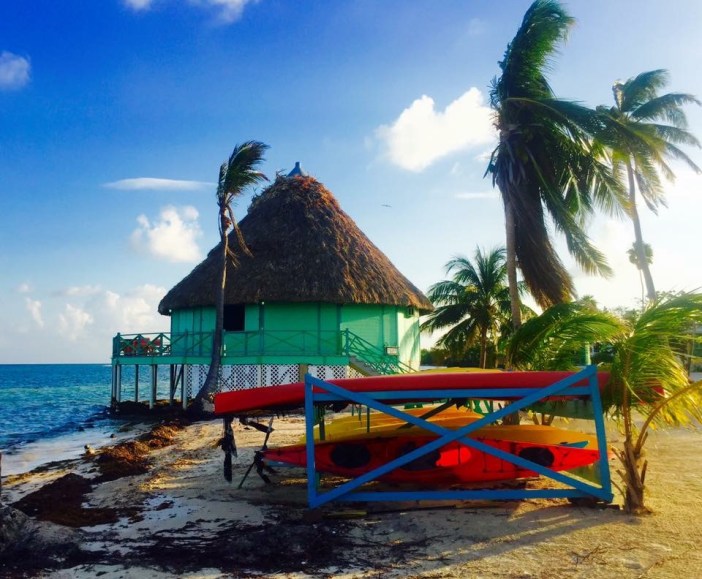
We had our own private bungalow on the island, the Honeymoon suite (no, we were not on our honeymoon!), located on stilts with an amazing views over the water (we arrived just prior to the full moon). It also had a hot tub, which sadly was not very full or very hot, and was supposed to be the nicest of the 24 rooms/bungalows in this completely self-sufficient resort consisting of its own restaurant, water desalination plant, dive center, and 3 dive boats. The package included 3 dives a day for 4 days, all meals and desalinated water, but sadly not the drinks (which at 10-15 USD each led to a hefty tap), as well as the option to spend a day at Lighthouse Reef to dive the Blue Hole and 2 other sites on the spectacular Half Moon Caye about a 1-hour boat ride away. The dive staff was very friendly and our Divemaster, Ed, a Belize native who grew up on one of the Cayes, was a pleasure to dive with and even taught James how to spear lionfish, which are not endemic to the Caribbean and have become a threat to the reef system (the staff cook was kind enough to make fish fingers for us after Ed filleted the fish). We had him to ourselves for 2.5 days, and when you are a seasoned diver, you cherish those days you don’t have to dive in a large group.
As is usual in February, the weather was mild and we experienced strong northeasterly winds during most of our stay, which was actually a relief, because when the wind was not blowing, we were constantly being bitten by sand fleas. The ocean temperature was a mild 26°C/79°F and I was pretty comfortable diving in my new 3/4mm wetsuit (James got cold in his 20-year old 3 mm suit). The mild water temperature, lack of strong currents, good visibility (averaging >20 meters), and all new dive equipment (buoyancy control device/BCD, regulators, & fins, all Christmas presents from family and James) made for very pleasant, easy diving. Though most of our dives were wall dives, we didn’t dive deeper than 20 meters (as Ed insisted most of the interesting things to see were at this depth).


In terms of underwater life, we were not overly impressed with the number and variety of fish we saw at Turneffe compared to other places we have dived (especially at Turneffe Elbow, touted to be an amazing site, but strangely devoid of fish on our outing). From what we heard, you do see much more aquatic life in the summer months (especially July). Our favorite sites on Turneffe were Coral Garden and Crab Walk, where we saw a hammerhead shark, a hawksbill turtle, multiple grouper, a lot of lobsters, some giant crabs, a few moral eels, a school of cuddle fish (a highlight!), and plenty of colourful, smaller reef fish, including angel fish, butterfly fish, blue chromis, and squirrel fish. Turneffe is a healthy reef with plenty of impressive coral, including giant brain coral, large barrel and yellow tube sponges, and Gorgonian sea fans, so even though we didn’t always see a lot of fish, diving amongst these corals was a great experience.We did 12 dives off of Turneffe and took half a day off to watch movies and hang out in our bungalow during a rainy afternoon on our next to last day. We also did one night dive, overpriced for what it was, but I did see my first flat lobster and someone consume 170 bar of air after 45 minutes at 10 meters depth!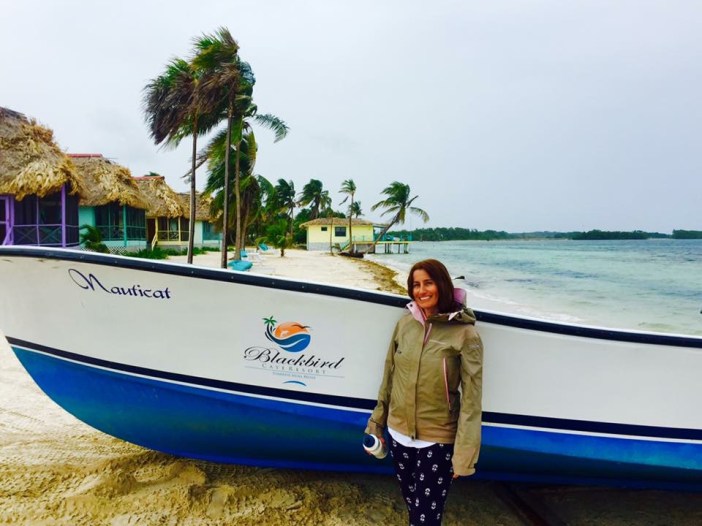
On Valentine’s Day, our last day of diving, we headed to Lighthouse Reef. At the Blue Hole and at Half Moon Caye, the underwater life became what we had expected of Belize. The Blue Hole is a gigantic sink hole, 300 meters in diameter, 108 meters deep, that was formed when an surface cave collapsed into the ocean after sea levels rose 15-150,000 years ago. At a depth of just below 40 meters, we entered a cave surrounded by stalagmites and stalactites. We also saw a passing Caribbean reef shark a good 5 meters below us when we were at 43 meters below sea level, my deepest dive yet (I logged 42 meters during my deep diver certification).
I must confess I was a little scared of diving the Blue Hole, as a guest at the resort had succumbed to his death 2 years prior, when he shot up to the surface. During our dive briefing, we were told we would be diving up to 45 meters below sea level. At this depth, you experience almost 5 times the amount of atmospheric pressure you do at sea level (14.7 pounds per square inch or psi, so multiply that times 5). One of the major downsides of diving at this depth, is the effect the increased partial pressure has on the absorption of nitrogen in mixed air (up to 78%; oxygen is only 21%) into tissues including the brain. At ≤30 meters below sea level, nitrogen has an intoxicating, anaesthetic effect leading to poor judgment also known as nitrogen narcosis.
At the 40 meter mark, as we descended into a midnight blue abyss, it got colder and darker, and I started to feel like everything was slowing down and like my teeth were going to cave in. Not being able to see the surface or the bottom, I decided to focus on the stalactites or giant hanging calcium icicles around me, hoping no equipment would suddenly fail, and that we would soon start ascending. We were only down there for 3 minutes, my dive watch beeping as alarms were going off telling me I had exceeded my maximum allowed depth and I was going into the decompression stage (when the nitrogen gases start to dissolve from the body’s tissues). I was glad when we finally started to make our slow ascent. We saw several lobsters hiding on these little holes on the wall on the way up as well as handfuls of Midnight parrotfish (of a rich blue colour) nibbling on the algae growing off the limestone walls of the Blue Hole. Amazing how these creatures can live at those depths!
Diving the Blue Hole is not for all, and many dive operations require that you are an Advanced Diver, as it seems bottomless and it is also very dark (I decided to use my flashlight), and without a point of reference, like the wall, divers can lose orientation and succumb to panic (diving accidents including a few fatalities have been known to happen). Many opt to go snorkeling by the rim instead, and wait for the divers to surface. The dive is short, only 30 minutes, so you can even wait on the boat. But I am glad I did it, as how often do you get to dive in the Blue Hole?!
After the Blue Hole we were taken to nearby Half Moon Caye for what many claim are the best 2 dives of the excursion. From the sandy shores of Half Moon Caye, you descend into a spectacular entrance into the reef, literally shaped like a crescent moon, and the contrast of white sand to the rich blue in front of you, with walls of reef on either side of you is really is a spectacular site. On our way into the entrance we saw several stingrays hovering above the sand, and on the wall itself, four Caribbean gray reef sharks patrolled us for most of the dive until we left the top wall onto the sandy slope (one got within a foot of me). At the end of the dive we saw a giant Loggerhead turtle chewing on the sea grass during our safety stop. The visibility and conditions were great. This dive was as spectacular as everyone said it would be!
After our second dive we had a nice long, picnic lunch at Half Moon Caye, designated a National Monument. This island was as close to paradise as you could imagine, with white sand beaches devoid of trash, pristine turquoise waters, plenty of palm trees, and both a frigate and red-footed boobie colony a short walk from shore. After our long safety stop, we did one last dive close to the island, known as Aquarium. Again, we saw plenty of rays, reef fish, a hawksbill turtle, a garden of small eels, and beautiful coral. It was a great, relaxing way to finish an eventful day of diving, and our last dive for a few months to come!
We enjoyed our week of diving in Belize. It was not as exciting as diving with schools of hammerhead sharks in the Galapagos in 18°C and strong currents wearing 7 mm wetsuits and 24 pounds of weight, or as magical as the swim through dives we did in the Coral Sea off of Australia in 40 meters of visibility and 29°C water temps, but it was pleasant enough diving capped by a spectacular day on Lighthouse Reef. Not to mention a great way to break the Colorado winter.
Belize is definately a dive destination worth visiting, with plenty of islands and dive sites to chose from for future visits. Next on our list are Placencia and Glovers Reef based on the local divermasters’ recommendations. Stay tuned!
Travel Tips:
Non-stop flights operate from Houston/Dallas, Miami and Atlanta for as little as 300 USD round-trip in the Winter months and circa 700 USD in the Summer.
Whale shark season is April, May and June.
Belize dollars are 2:1 to the US dollar but most merchants accept USD.
No electrical converters needed!
Don’t forget your bug repellent 🙂
For more info on where to dive check out:https://www.padi.com/scuba-vacations/belize
Dive resorts in Belize by popularity (though Blackbird doesn’t seem to be in there): https://www.tripadvisor.com/HotelsList-Belize-Diving-Resorts-zfp4099.html
 thebearthatmoved.com